When a servo motor and the driven axis need to sit at 90 degrees, engineers usually choose between two very different technologies: a worm gearbox for a servo motor, or a right angle servo gearbox built on planetary gear stages. Both redirect the drive by 90 degrees. Both fit into compact machine frames. But they behave very differently once the servo motor runs at higher speed, reverses direction frequently, or needs to hold a precise stop position.
This comparison is written for machine builders who already know they need a 90-degree drive and now need to decide which gear technology actually fits their servo application — not a general-purpose reducer running at constant, low-demand speed.
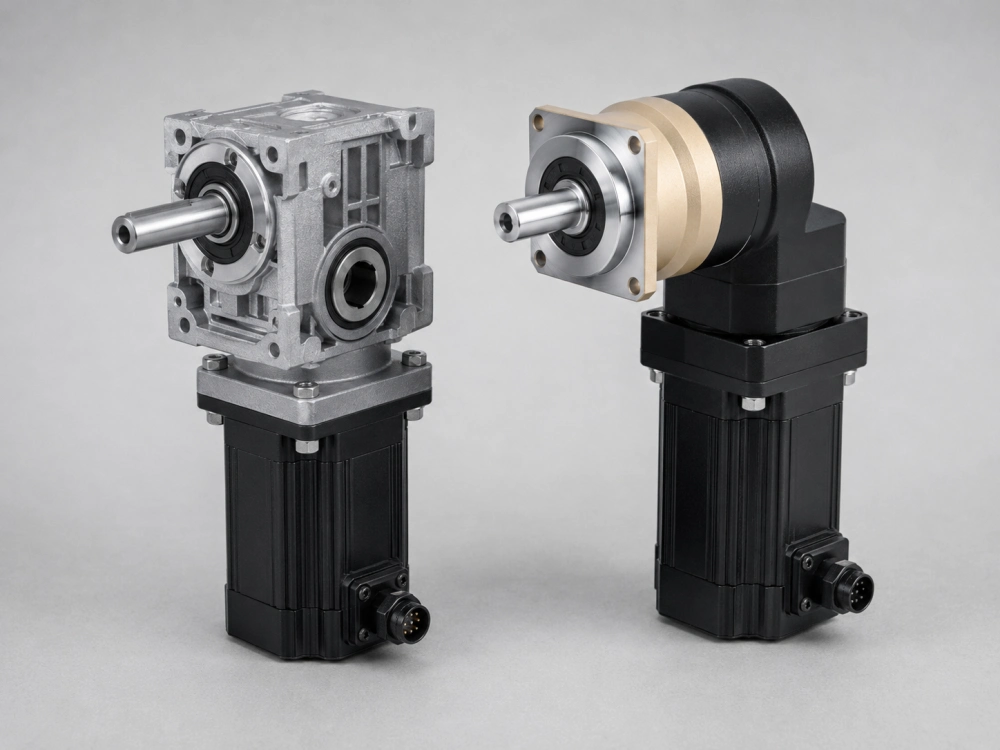
A worm gearbox and a right angle servo gearbox both redirect the drive axis, but their internal gear mesh behaves very differently under servo dynamics.
Two Different Ways to Build a Right Angle Servo Gearbox
A worm gearbox for a servo motor uses a worm screw meshing with a worm wheel. The design is simple, compact for its ratio, and naturally self-locking in many configurations — the load cannot back-drive the motor when power is off. This made worm gearing popular for decades in general industrial drives, hoists, and manually indexed equipment.
A planetary-based right angle servo gearbox uses a bevel or hypoid stage to redirect the axis, combined with planetary gear stages to provide reduction and torque multiplication. Load is shared across multiple planet gears instead of a single sliding worm-wheel contact, which changes almost everything about how the gearbox behaves under servo control.
The mechanical difference between sliding contact (worm) and rolling, multi-tooth contact (planetary right angle servo gearbox) is the reason these two solutions perform so differently once a servo controller — not a constant-speed motor — is driving them.
High Speed Right Angle Gearbox Performance: Where the Real Difference Shows Up
Worm gearboxes rely on sliding friction between the worm and the wheel. At low speed, this is manageable. As input speed rises, sliding friction generates more heat, and lubrication has to work harder to prevent wear. This is why a high speed right angle gearbox built on worm technology is uncommon in continuous-duty servo applications — thermal limits, not torque limits, usually set the ceiling.
A planetary-based right angle servo gearbox uses rolling gear mesh with load distributed across multiple planet gears. It tolerates higher input speeds with less heat generation for a given torque, which matches the way servo motors actually operate — frequently running near their rated speed, not just at low RPM. This is the core reason a high speed right angle gearbox requirement usually points toward a planetary design rather than a worm design.
For applications like indexing stations, pick-and-place axes, and packaging machines where the servo motor accelerates, decelerates, and reverses many times per minute, a high speed right angle servo gearbox built on planetary stages generally sustains higher duty cycles without the thermal derating that worm gearboxes require.
Backlash and Positioning Accuracy
Backlash is where the two technologies diverge most for closed-loop servo systems. A worm gear mesh typically carries more backlash than a precision right angle servo gearbox, and that backlash can increase over time as the worm wheel wears from sliding contact. For applications that only need to move a load in one direction without stopping at an exact point, this may not matter.
For positioning tasks — robotic auxiliary axes, dial indexing, vision-guided assembly, synchronized multi-axis motion — backlash directly affects repeatability. A low-backlash right angle servo gearbox holds its specification more consistently over its service life because the load path does not depend on sliding wear the way a worm mesh does.
Efficiency and Heat Generation
Worm gearboxes are known for relatively low mechanical efficiency, especially at higher ratios, because sliding friction converts a meaningful portion of input energy into heat rather than output torque. Depending on ratio and lead angle, worm gear efficiency can fall well below that of a planetary-based right angle servo gearbox.
A right angle servo gearbox built on planetary stages generally runs cooler and more efficiently at comparable torque and speed, which matters for two practical reasons: lower running cost over the machine’s life, and less heat feeding back into the servo motor and surrounding components — a real concern in sealed or compact machine enclosures.
Self-Locking: The One Advantage Worm Gearing Still Holds
Worm gearboxes are not obsolete. Their sliding-contact design gives many worm configurations a natural self-locking property — the output cannot drive the input backward under normal load. On a vertical axis, tilting fixture, or manually adjusted mechanism, this can remove the need for a separate holding brake.
A right angle servo gearbox built on planetary stages does not self-lock the same way. If a servo axis needs to hold position under gravity load when power is removed, the system typically relies on a motor brake or an external locking mechanism rather than the gearbox itself. This is a real design trade-off, not just a specification difference, and it should be decided early — not discovered during commissioning.
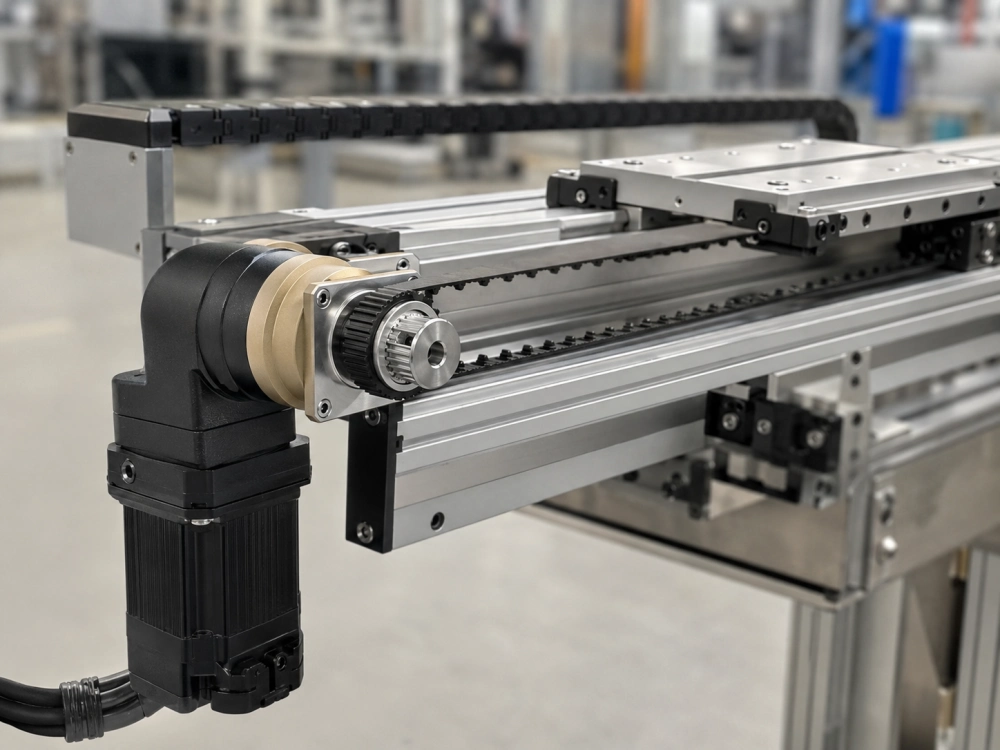
In duty-cycle-heavy automation axes, a high speed right angle servo gearbox typically sustains higher speed and repeat accuracy than a worm gear equivalent.
Right Angle Servo Gearbox vs Worm Gearbox: Side-by-Side Comparison
| Factor | Worm Gearbox for Servo Motor | Right Angle Servo Gearbox (Planetary) |
|---|---|---|
| High speed servo input | Limited by heat and wear | Generally well suited |
| Backlash over service life | Tends to increase with wear | More stable when properly specified |
| Efficiency | Lower, especially at high ratios | Higher for comparable torque |
| Self-locking / holding load | Often self-locking | Usually needs a motor brake |
| Duty cycle suitability | Better for light, intermittent use | Better for continuous, high-cycle motion |
| Typical cost at small size | Often lower | Typically higher, reflects precision build |
When a Worm Gearbox for a Servo Motor Still Makes Sense
A worm gearbox for a servo motor can still be a reasonable choice when the axis moves infrequently, when self-locking removes the cost of a separate brake, when backlash requirements are loose, or when budget is the primary constraint and duty cycle is light. Manual adjustment mechanisms, low-cycle tilting fixtures, and some low-speed positioning tasks fall into this category.
When a High Speed Right Angle Servo Gearbox Is the Better Fit
For applications where the servo motor runs near its rated speed, cycles frequently, reverses direction often, or must hold a precise stop position repeatedly, a right angle servo gearbox built on planetary stages is generally the more reliable choice. This includes packaging equipment, automated assembly stations, indexing tables, robotic auxiliary axes, and any machine where positioning accuracy directly affects product quality or throughput.
Zhuochuang’s right angle servo gearbox range, including the VRBR series and ZCDR series, is built for high speed, duty-cycle-heavy servo applications, with motor adapters matched to common servo brands and backlash grades suited to precision positioning.
What to Confirm Before Choosing Between the Two
Before deciding between a worm gearbox for a servo motor and a right angle servo gearbox, it helps to have clear answers to a few questions:
- How many cycles per minute or per hour will the axis run, and for how many hours per day?
- Does the machine need to hold position under load when power is removed, or is a motor brake already part of the design?
- What backlash and repeatability does the application actually require?
- Will the servo motor run near its rated speed continuously, pointing toward a high speed right angle gearbox requirement?
- Is there a budget constraint that makes a lower-cost worm solution acceptable for a lighter-duty axis?
A manufacturer that supports both mechanical types can compare these answers against real gearbox data rather than general assumptions. Dongguan Zhuochuang Precision Machinery Co., Ltd designs right angle servo gearbox solutions for automation, robotics, CNC, and packaging equipment, and can help review whether a planetary or alternative solution fits a specific duty cycle and accuracy target.
Conclusion
A worm gearbox for a servo motor and a right angle servo gearbox solve the same layout problem — a 90-degree drive — through very different mechanics. Worm gearing offers simplicity, self-locking, and lower cost for light, intermittent duty. A right angle servo gearbox built on planetary stages offers lower backlash, higher efficiency, and better sustained performance as a high speed right angle gearbox, which is why it is the more common choice for continuous, high-cycle automation axes.
The right decision depends on duty cycle, speed, backlash requirement, and whether the axis needs to self-lock. For applications where the servo motor is expected to run hard, stop precisely, and repeat that cycle for years without drifting out of specification, a right angle servo gearbox is generally the safer engineering choice.
If you are comparing a worm gearbox against a right angle servo gearbox for a new servo axis, contact zhuochuang engineering team with your servo motor model, target speed, duty cycle, and backlash requirement for a direct recommendation.
FAQ
Is a worm gearbox suitable for a servo motor?
Yes, for light or intermittent duty where self-locking is useful and backlash requirements are moderate. For continuous, high-speed, or precision positioning applications, a right angle servo gearbox built on planetary stages usually performs better.
What makes a right angle servo gearbox a high speed right angle gearbox?
Its rolling planetary gear mesh generates less heat than a worm gear’s sliding contact at comparable speed, allowing it to sustain higher continuous input speeds without thermal derating.
Does a right angle servo gearbox need a brake to hold position?
In most cases, yes. Unlike many worm gearbox designs, a planetary-based right angle servo gearbox is not inherently self-locking, so a motor brake or external lock is typically used when the axis must hold load with power removed.
Which option has lower backlash, worm or right angle servo gearbox?
A precision right angle servo gearbox generally holds a lower and more stable backlash over its service life than a worm gearbox for a servo motor, which can see backlash increase as the worm wheel wears.
Is a worm gearbox cheaper than a right angle servo gearbox?
At small sizes and light duty, worm gearboxes are often less expensive. For high speed, high-cycle servo applications, the total cost of ownership can favor a right angle servo gearbox once efficiency, wear, and maintenance are factored in.
Can Zhuochuang help decide between a worm gearbox and a right angle servo gearbox?
Yes. Provide your servo motor model, target speed, duty cycle, backlash requirement, and whether the axis needs to hold position under power-off conditions, and our team can recommend a suitable right angle servo gearbox configuration.
Related Reading
- Right Angle Servo Gearbox Selection Guide — backlash, torque, motor interface, and replacement checklist for servo applications.
- Right Angle Planetary Gearbox for Servo Drive Layouts — when a 90-degree layout makes sense versus an inline gearbox.
- 90 Degree Gear Reducer Applications — common machine layouts that require a perpendicular drive.