Gearbox Drive vs Direct Drive
Both gearbox drive and direct drive systems can move industrial machines, but they solve different motion problems. The right choice depends on torque, speed, accuracy, cost, machine layout, and how the load behaves during operation.
Basic Difference Between Gearbox Drive and Direct Drive
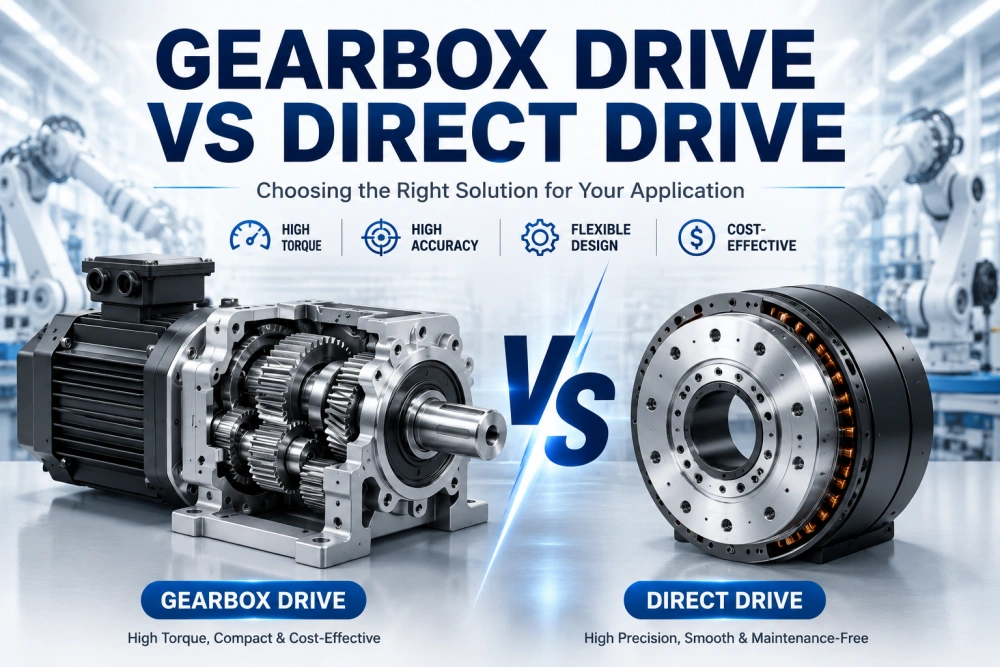
A gearbox drive uses a gearbox between the motor and the load. The gearbox changes the motor’s output speed and torque before the motion reaches the machine. This makes the motor output more suitable for many industrial loads.
A direct drive connects the motor more directly to the load, without a conventional gearbox. The motor must provide the required torque, speed, and control performance by itself. This can reduce mechanical parts, but it also places higher demands on the motor and control system.
When a Gearbox Drive Works Better
A gearbox drive is often a practical choice when the machine needs lower output speed, stronger torque, compact motor size, or flexible installation. In many automation systems, the motor speed is too high and the load speed is much lower. A gearbox helps connect these two sides more efficiently.
Gearbox drive systems are also useful when a machine needs a right angle layout. For example, the motor may not fit directly in line with the driven shaft. In this case, a right angle gearbox drive can change the direction of power and make the machine structure more compact.
Higher Usable Torque
Gearbox ratio helps convert motor speed into stronger output torque, which is useful for conveyors, lifting units, rotary tables, and heavy load mechanisms.
Smaller Motor Choice
A suitable gearbox can allow a smaller motor to drive the load, reducing motor size and making the drive package more practical.
Flexible Installation
Inline, right angle, and planetary gearbox layouts allow engineers to fit the drive system into different machine designs.
Cost-Effective Motion
Compared with high-torque direct drive motors, a gearbox drive can be more economical for many standard industrial applications.
When Direct Drive Works Better
Direct drive can be useful when the machine requires very smooth motion, minimal mechanical transmission error, fewer mechanical parts, or very low maintenance. Because there is no traditional gearbox, backlash from gear engagement can be avoided.
However, direct drive systems often require larger motors, stronger control capability, and more careful thermal and structural design. They may also increase cost when high torque is needed at low speed.
- Direct drive is useful for applications requiring very smooth rotation.
- It can reduce mechanical backlash caused by gear engagement.
- It may reduce the number of transmission components.
- It can be more expensive when high torque is required.
- It may require a larger motor or more advanced control system.
Gearbox Drive vs Direct Drive Comparison
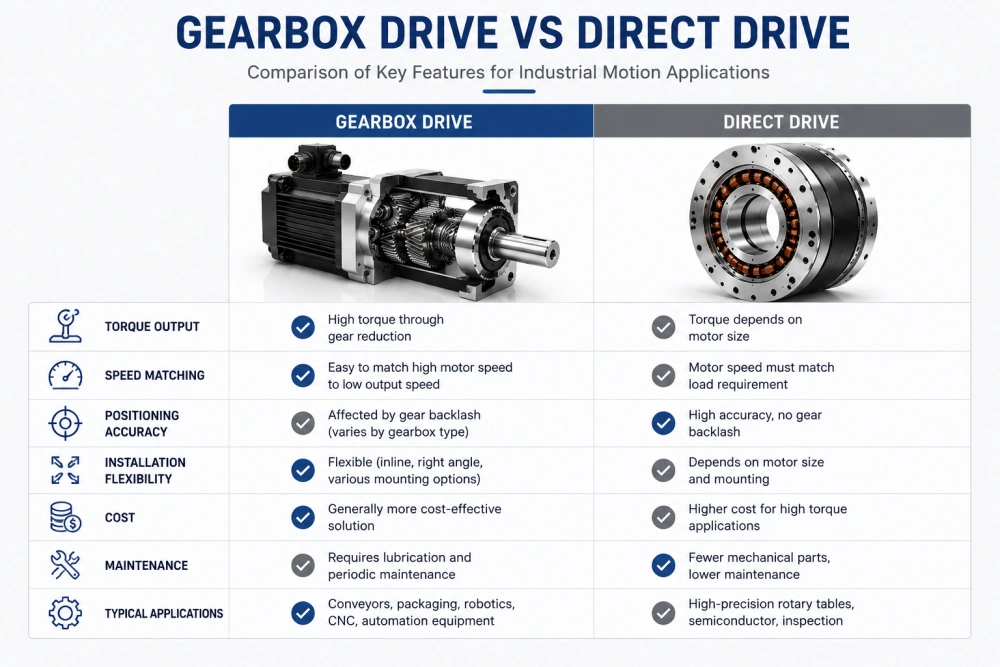
The best choice depends on the application. The table below compares the two drive methods from a practical industrial design perspective.
| Factor | Gearbox Drive | Direct Drive |
|---|---|---|
| Torque Output | Good for increasing usable torque through gear ratio | Requires the motor to provide torque directly |
| Speed Matching | Good for reducing high motor speed to practical machine speed | Motor speed must match the load requirement more directly |
| Backlash | Depends on gearbox type and precision level | No gear backlash from a conventional gearbox |
| Machine Layout | Flexible with inline, right angle, and planetary configurations | Layout depends more on motor size and mounting position |
| Cost | Often cost-effective for standard automation | Can be more expensive for high torque or large loads |
| Maintenance | Gearbox lubrication and wear should be considered | Fewer transmission parts, but motor and control requirements may be higher |
How to Choose Between Gearbox Drive and Direct Drive
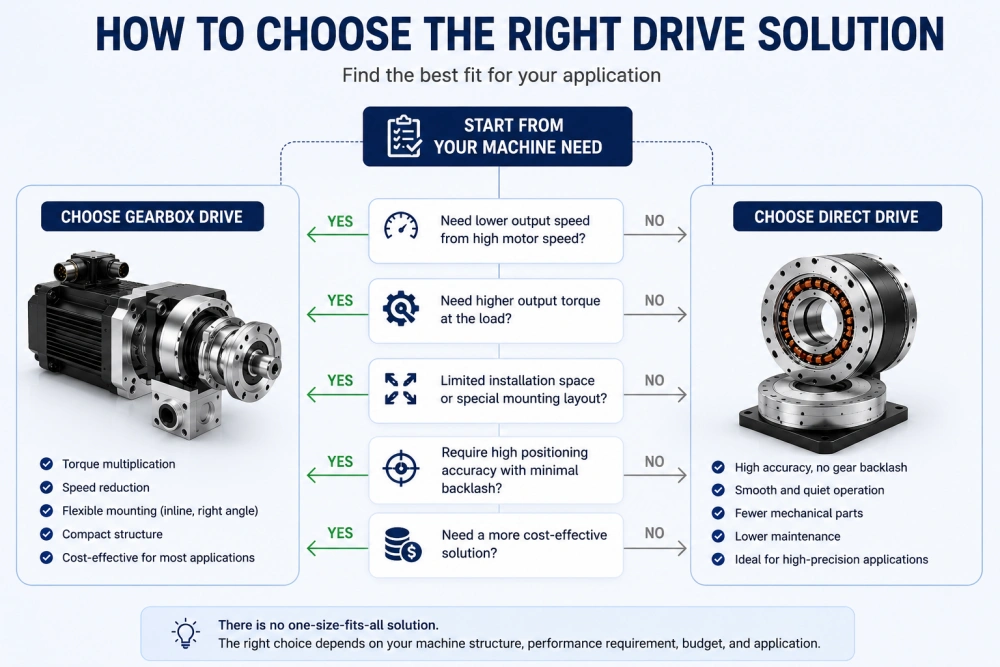
The choice should start from the machine task. If the load needs high torque at low speed, a gearbox drive is often easier to apply. If the system needs extremely smooth rotation and the motor can directly meet the torque requirement, direct drive may be worth considering.
Choose a gearbox drive when:
- The motor speed is much higher than the required machine speed.
- The system needs stronger output torque.
- The machine needs compact or right angle installation.
- The project needs a practical and cost-effective drive structure.
- The application uses a servo motor but still needs ratio matching.
Choose direct drive when:
- The motor can directly meet the torque and speed requirement.
- The system requires very smooth motion with minimal mechanical transmission error.
- The machine can accept a larger motor size or higher motor cost.
- The design wants to reduce mechanical transmission parts.
Application Examples
In automation equipment, gearbox drive systems are commonly used in conveyors, packaging machines, rotary indexing tables, CNC auxiliary mechanisms, and robotic motion modules. These applications often need torque multiplication, speed reduction, and compact mounting.
Direct drive is more likely to appear in applications where smooth rotation, high response, and minimal mechanical transmission error are more important than low cost or compact motor size.
- Conveyors: gearbox drive is commonly used for speed reduction and stable torque.
- Packaging machines: gearbox drive supports repeated motion and compact layouts.
- Rotary indexing systems: gearbox or rotary drive modules help control angle positioning.
- High-end rotary stages: direct drive may be selected when backlash must be minimized.
Related Gearbox and Motion Resources
For product-level research, users can review servo planetary gearbox solutions when the application needs compact torque transmission, low backlash, or right angle gearbox layouts.
For rotary indexing and positioning applications, users can also review hollow rotary table and servo indexing solutions when the machine requires repeatable angle positioning or hollow center routing.
FAQ
Is direct drive always more accurate than gearbox drive?
Not always. Direct drive can avoid gearbox backlash, but total system accuracy also depends on motor control, encoder feedback, mechanical stiffness, load condition, and machine structure.
Why do many automation machines still use gearbox drives?
Gearbox drives are practical because they provide speed reduction, torque increase, flexible layout, and cost-effective motor matching for many industrial machines.
Is a planetary gearbox drive suitable for servo motors?
Yes. Planetary gearbox drives are commonly used with servo motors because they provide compact size, high torque density, and good rigidity for automation applications.
When should I avoid a gearbox drive?
If the application needs extremely smooth direct rotation, very low transmission error, and the motor can directly meet the torque requirement, direct drive may be a better option.
Need Help Comparing Gearbox Drive and Direct Drive?
Contact Gearbox Drive if you are evaluating torque, speed, machine layout, servo gearbox options, or rotary motion solutions for industrial automation.
Take a quick look inside the planetary gearbox manufacturing workshop.
I learn these:
✔ Planetary Gearboxes
✔ Servo Gear Reducers
✔ Hollow Rotary Tables
✔ Motion Control Solutions
Applications:
• Robotics
• CNC Machinery
• Automation Equipment
• Packaging Machines
• Semiconductor Systems
Interseted in following resources
Website:
https://planetdrivepro.com
Request a Quote:
https://planetdrivepro.com/contact/
#planetarygearbox
#servo
#automation
#robotics
#cnc
#motioncontrol
#hollowrotarytable