Gearbox Guide
Right Angle Gearbox Drive Applications
A right angle gearbox drive is used when a machine needs to change the direction of motor power by 90 degrees. In compact automation equipment, this layout helps save space, improve machine structure, and connect the motor to the driven load more efficiently.
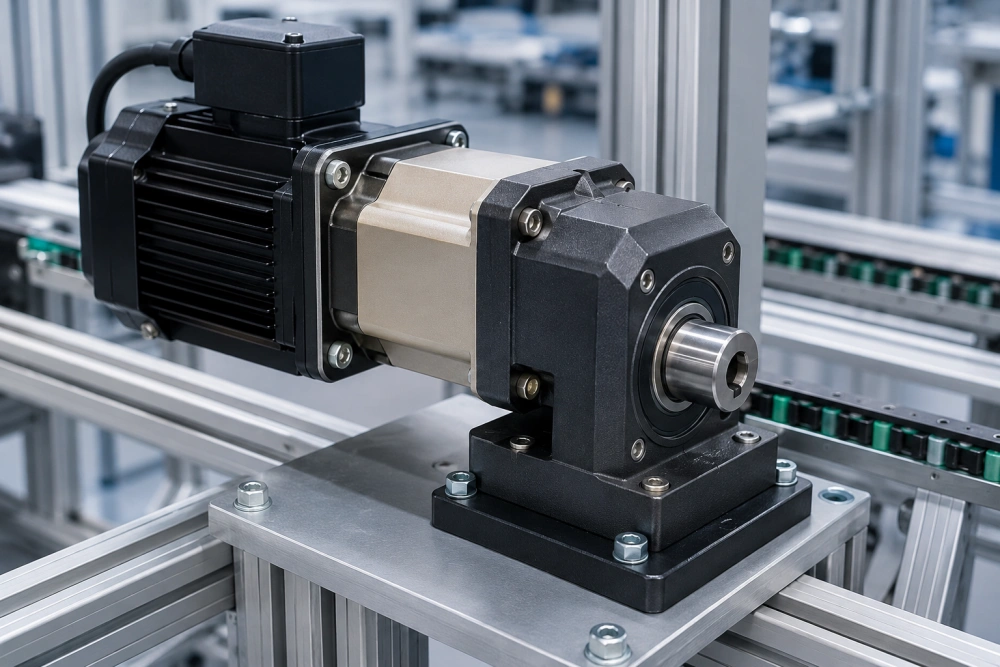
What Is a Right Angle Gearbox Drive?
A right angle gearbox drive is a mechanical transmission system that changes the direction of rotation between the input and output shaft. Instead of keeping the motor and output shaft in a straight line, the gearbox turns the power path by 90 degrees.
This structure is useful when the motor cannot be installed directly behind the driven shaft. It is commonly used in automation equipment, packaging machines, conveyors, indexing systems, and compact servo-driven machinery.
Why Compact Machines Use Right Angle Gearbox Drives
Many machines have limited space around the moving mechanism. A straight inline gearbox may make the machine too long or interfere with nearby components. A right angle gearbox drive allows the motor to be mounted from the side, which helps make the machine layout more compact.
In automation design, this can be important for reducing machine length, improving cable routing, keeping the motor away from the working area, and making maintenance easier.
Main advantages
- Space-saving layout: useful when the motor cannot be installed in line with the output shaft.
- 90-degree power transmission: changes motion direction without adding complex machine parts.
- Better machine integration: helps fit the drive unit into compact frames and enclosed equipment.
- Servo motor compatibility: suitable for controlled speed, positioning, and repeated motion.
- Cleaner structure: can reduce unnecessary belts, brackets, or long couplings.
Common Right Angle Gearbox Drive Applications
Right angle gearbox drives are used in many machines where layout direction matters as much as torque and speed. They are especially helpful when the motor must be kept away from the main moving axis.
Typical application areas
- Packaging equipment: used in labeling machines, sealing units, filling machines, and rotary packaging stations.
- Conveyor systems: useful when the motor needs to be mounted beside the conveyor frame.
- Automation modules: applied in transfer stations, pick-and-place units, and compact linear systems.
- Rotary indexing systems: used where side-mounted servo power is needed for repeated angle movement.
- CNC auxiliary mechanisms: used in tool changers, feeding systems, and space-limited machine structures.
- Inspection equipment: supports camera positioning, rotating fixtures, and controlled adjustment mechanisms.
Right Angle Gearbox Drive with Servo Motors
When a right angle gearbox is used with a servo motor, selection becomes more than a simple 90-degree layout decision. The gearbox must also match the servo motor speed, torque, backlash requirement, mounting size, and load inertia.
For servo automation systems, low backlash and rigidity are important because the gearbox is part of the motion control chain. If the gearbox has too much clearance or weak structure, the final machine movement may lose accuracy during reversing, indexing, or positioning.
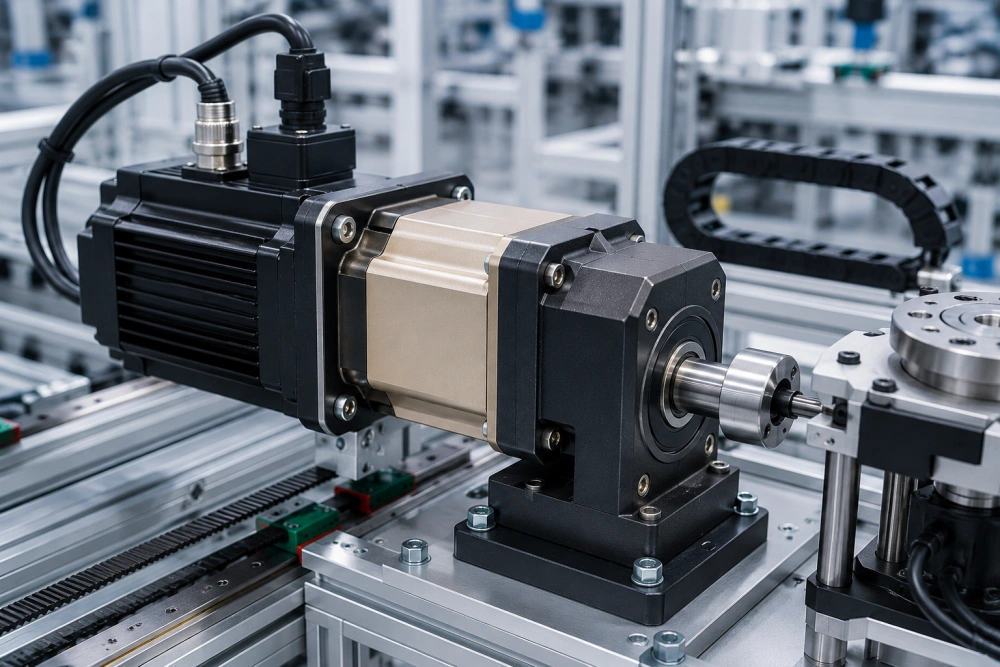
For compact machinery that needs a 90-degree servo transmission layout, a right angle planetary gearbox for automation equipment can be reviewed as a related product reference.
Selection Points for a Right Angle Gearbox Drive
A right angle gearbox drive should be selected according to both the mechanical layout and the motion requirement. A gearbox may fit the space, but it still needs to meet torque, speed, backlash, and service life requirements.
Important points to check
- Output torque: confirm rated torque and peak torque for the application.
- Gear ratio: match motor speed to the required output speed.
- Backlash: check whether the application needs low backlash for positioning or reversing motion.
- Mounting direction: confirm motor side, output shaft direction, and available machine space.
- Servo motor fit: check motor flange, shaft diameter, adapter size, and installation method.
- Duty cycle: consider continuous running, frequent start-stop movement, and shock load.
- Environment: check dust, temperature, lubrication, sealing, and maintenance conditions.
Right Angle Gearbox Drive vs Inline Gearbox Drive
An inline gearbox drive is suitable when the motor and output shaft can stay on the same axis. It is simple and efficient for straight-line layouts. A right angle gearbox drive is better when the machine needs to save length or change the direction of power transmission.
| Drive Layout | Best For | Main Advantage |
|---|---|---|
| Inline Gearbox Drive | Straight motor-to-load connection | Simple shaft alignment and compact axial structure |
| Right Angle Gearbox Drive | Space-limited or side-mounted motor layouts | Changes power direction by 90 degrees |
FAQ
What is a right angle gearbox drive used for?
It is used to change the direction of motor power by 90 degrees, especially in machines where the motor cannot be installed directly in line with the output shaft.
Is a right angle gearbox suitable for servo motors?
Yes. A right angle gearbox can work with servo motors when the ratio, torque, backlash, rigidity, and mounting size are properly matched.
When should I choose right angle instead of inline?
Choose a right angle gearbox when the machine has limited length, side-mounted motor requirements, or a layout that needs 90-degree power transmission.
Does backlash matter in a right angle gearbox drive?
Yes. Backlash is important for servo positioning, indexing, reversing motion, robotic axes, and inspection systems where repeatability matters.
Conclusion
A right angle gearbox drive is useful for compact machinery because it changes the direction of power transmission and helps save installation space. In servo-driven automation systems, the gearbox should be selected by checking ratio, torque, backlash, rigidity, mounting direction, and duty cycle together.
For applications that need a compact 90-degree transmission layout, related right angle planetary gearbox options can help buyers compare product direction before final model selection.