Gearbox Guide
Planetary Gearbox Drive for Automation
A planetary gearbox drive is widely used in automation equipment because it can deliver high torque, compact size, stable speed reduction, and reliable servo motor matching. In many machines, it helps convert motor power into practical motion for positioning, conveying, indexing, lifting, and rotary movement.
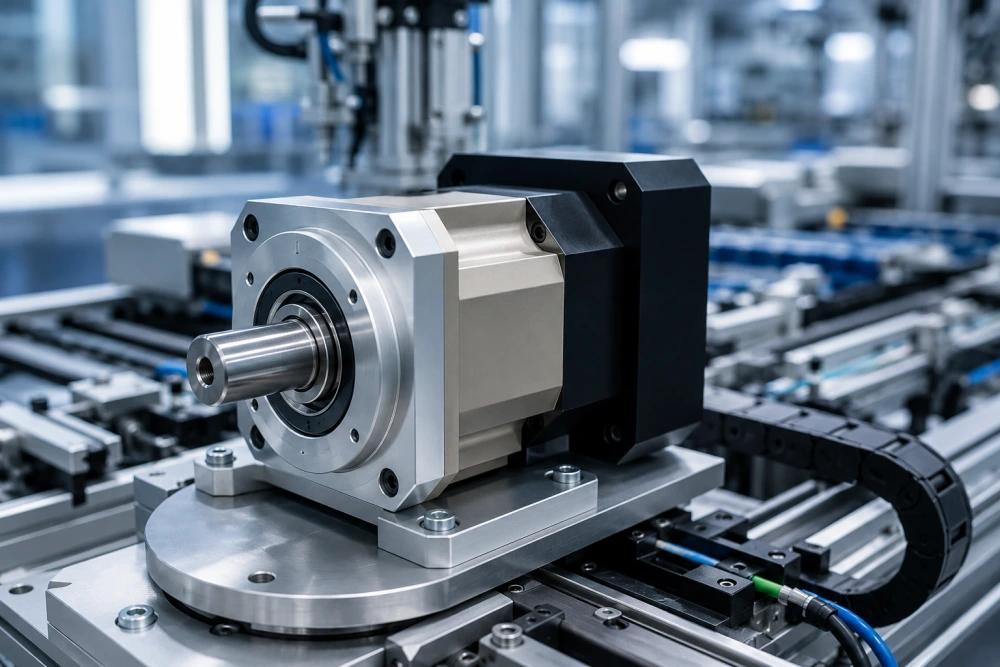
What Is a Planetary Gearbox Drive?
A planetary gearbox drive is a compact gear reduction system that uses a sun gear, planet gears, and a ring gear to transfer motion from a motor to a machine load. The gear structure allows torque to be shared by multiple planet gears, which helps improve torque capacity and mechanical rigidity within a compact body.
In automation equipment, the motor usually runs at high speed, while the machine load often needs lower speed and stronger torque. A planetary gearbox drive helps reduce motor speed and increase usable output torque, making the motor more suitable for the final mechanical task.
Why Planetary Gearbox Drives Are Used in Automation
Automation machines often need repeated movement, controlled acceleration, compact installation, and stable output. A planetary gearbox drive is useful because it combines torque density, speed reduction, and good mechanical stiffness in one compact unit.
Main benefits
- Compact torque transmission: suitable for machines with limited installation space.
- Speed reduction: converts high motor speed into practical machine speed.
- Servo motor matching: helps match motor speed and load inertia.
- Better rigidity: supports more stable motion and positioning behavior.
- Flexible ratios: allows the drive system to match different output speed requirements.
How a Planetary Gearbox Drive Supports Servo Motors
Servo motors are used for accurate speed and position control. However, a servo motor alone may not always match the machine load. The load may require higher torque, lower speed, or better inertia matching. A planetary gearbox drive helps the servo motor work within a more useful operating range.
For positioning systems, backlash and rigidity are important. A low backlash planetary gearbox can help reduce lost motion during direction changes, while higher torsional stiffness can improve motion response under load.
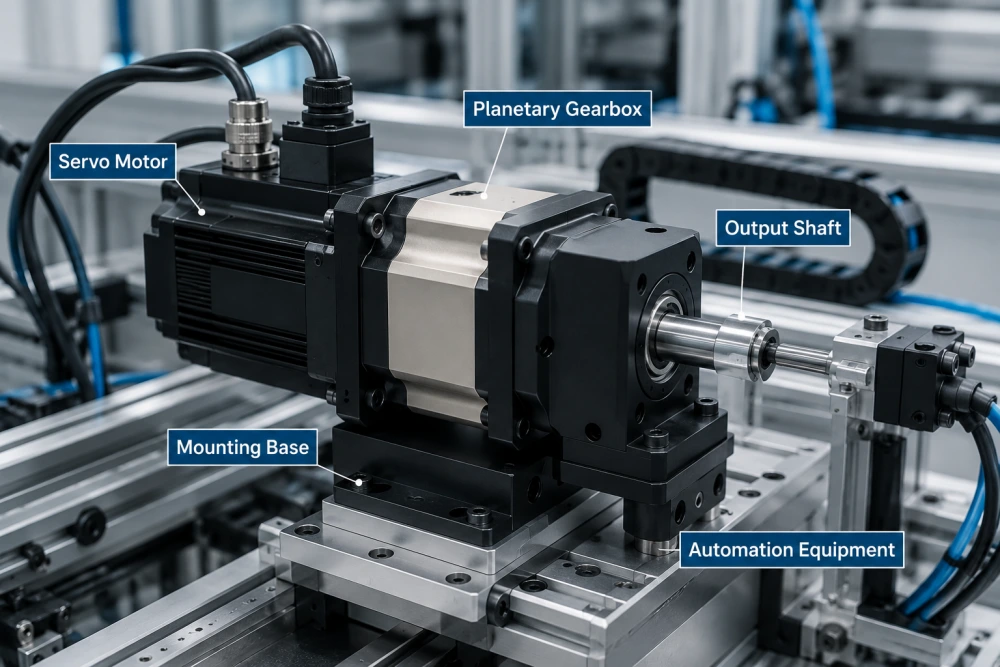
Common Automation Applications
Planetary gearbox drives are used in many automation machines where direct motor output is not suitable for the load. They are especially useful when the machine requires controlled speed, repeatable movement, compact structure, or stronger output torque.
Typical applications include:
- Pick-and-place automation modules
- Robotic joints and rotary axes
- Conveyor drive systems
- Packaging equipment and labeling machines
- CNC auxiliary axes and tool changers
- Inspection fixtures and positioning stages
- Rotary indexing and assembly stations
Inline and Right Angle Planetary Gearbox Layouts
Planetary gearbox drives can be designed in inline or right angle layouts. An inline gearbox is suitable when the motor and output shaft can stay on the same axis. A right angle gearbox is useful when the motor needs to be mounted from the side because of limited machine space.
For compact automation equipment, a right angle planetary gearbox for compact automation layouts can be useful when the machine needs 90-degree transmission, servo motor matching, and space-saving installation.
Selection Points for a Planetary Gearbox Drive
Selecting a planetary gearbox drive should start from the machine requirement, not only from the motor size. The gearbox must match the load, output speed, torque demand, accuracy requirement, and installation layout.
Important points to check
- Gear ratio: choose a ratio that matches motor speed to required output speed.
- Rated torque: confirm the gearbox can handle normal working torque.
- Peak torque: check acceleration, stop, reverse, and shock load conditions.
- Backlash: important for positioning, indexing, and servo control systems.
- Rigidity: affects motion stability and response under load.
- Mounting size: confirm motor flange, shaft, and machine installation space.
- Duty cycle: consider running time, stop time, cycle frequency, and service life.
Planetary Gearbox Drive vs Other Gearbox Types
Compared with some other gearbox structures, planetary gearbox drives are often selected when compact size and high torque density are important. They are also common in servo applications because they can provide good rigidity and ratio options for automation systems.
| Gearbox Type | Typical Strength | Common Use |
|---|---|---|
| Planetary Gearbox Drive | Compact size, high torque density, good rigidity | Servo automation, robotics, positioning systems |
| Worm Gear Drive | High reduction ratio and right angle transmission | Simple machinery and low-speed applications |
| Direct Drive | No conventional gearbox backlash | High-end rotary stages and special motion systems |
FAQ
Why is a planetary gearbox drive common in automation?
It provides compact torque transmission, speed reduction, servo motor matching, and good rigidity, which are useful for many automation systems.
Is a planetary gearbox suitable for servo motors?
Yes. Planetary gearboxes are commonly used with servo motors because they provide ratio options, compact size, high torque density, and better motion stability.
When should I choose a right angle planetary gearbox?
A right angle planetary gearbox is useful when the motor cannot be installed in line with the output shaft or when the machine has limited installation space.
Does low backlash matter for automation?
Yes, especially for positioning, indexing, reversing movement, robotic axes, inspection systems, and servo-controlled applications.
Conclusion
A planetary gearbox drive is a practical solution for many automation machines because it helps match motor speed, increase usable torque, support compact installation, and improve motion stability. For servo-driven systems, ratio, torque, backlash, rigidity, and layout should be checked together before choosing a gearbox.
For more product-level research, users can review servo planetary gearbox solutions and compare suitable gearbox layouts for automation equipment.